
How do you write an equation in point-slope form?
Put the slope in place of m, and the coordinates of a point you know in place of x₁ and y₁. Leave x and y as letters. They stand for every other point on the line. Use point-slope form when you know one point on the line and its slope.
Example
Write the line through (2, 3) with slope 2.
- The point gives x₁ = 2 and y₁ = 3.
- The slope gives m = 2.
- Substitute: y − 3 = 2(x − 2).
You're done, and there's nothing to simplify. If you want to be sure, test a second point. One step right and two steps up from (2, 3) lands on (3, 5). Put those numbers in: 5 − 3 = 2 on the left, 2(3 − 2) = 2 on the right. They match.
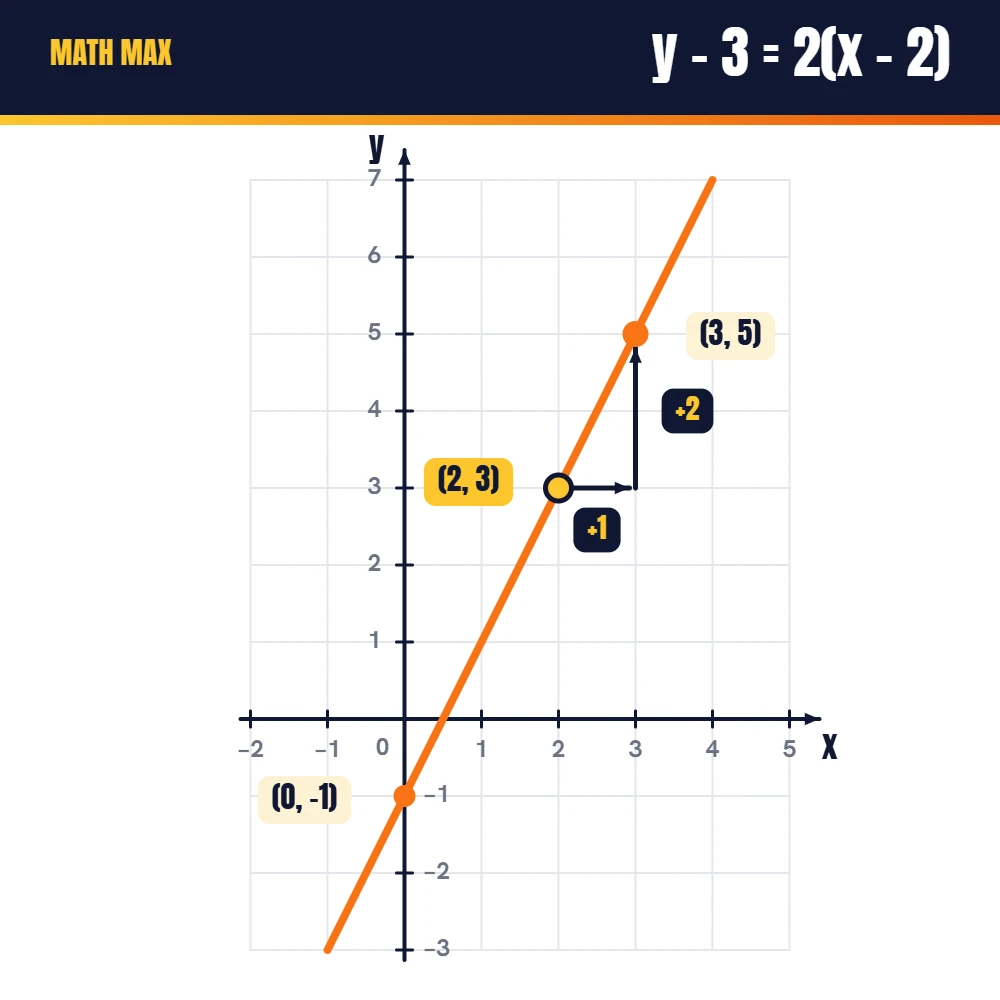
Notice that (2, 3) sits right inside the equation. When you graph it, you can put your pencil on that point first and work out from there.
How do you find point-slope form from two points?
Work out the slope first with m = (y₂ − y₁) ÷ (x₂ − x₁). Then take either of the two points and put it into y − y₁ = m(x − x₁) together with that slope. It doesn't matter which point you choose. The equations look different, but after simplifying both describe the same line.
Example
Find the line through (1, −2) and (4, 7).
- Slope: m = (7 − (−2)) ÷ (4 − 1) = 9 ÷ 3 = 3
- Using (1, −2): y − (−2) = 3(x − 1), so y + 2 = 3(x − 1)
- Using (4, 7): y − 7 = 3(x − 4)
Multiply out either one and you get y = 3x − 5. This is worth knowing before you check homework against an answer key. A student who used (4, 7) and a key that used (1, −2) will show two different equations, and neither of them is wrong.
Why does a negative point change the signs?
The formula subtracts the point's coordinates. If a coordinate is negative, you end up subtracting a negative number, and that turns into a plus. So the point (−4, −1) gives y + 1 and x + 4. Writing the brackets out in full before you tidy up is the simplest way to stop the sign from flipping the wrong way.
Example
Write the line through (−4, −1) with slope 1/2.
- With brackets: y − (−1) = 1/2(x − (−4))
- Tidied up: y + 1 = 1/2(x + 4)
It works in reverse as well. Given y + 5 = −2(x − 6), the point on the line is (6, −5), not (6, 5). Whatever sign you see inside the equation, the coordinate has the opposite one.
How do you convert point-slope form to slope-intercept form?
Multiply out the bracket, then move the number on the left side across so y stands alone. What you get is slope-intercept form, y = mx + b. The slope doesn't change during the conversion, and the number left on its own at the end is the y-intercept, where the line crosses the y-axis.
Example
Convert y − 3 = 2(x − 2).
- Multiply out the bracket: y − 3 = 2x − 4
- Add 3 to both sides: y = 2x − 1
The slope is still 2, and the line crosses the y-axis at (0, −1). You can see that point on the graph above. Going the other way is just as quick. Take y = −3x + 5, pick x = 1, and you get y = 2. The point (1, 2) and the slope −3 give y − 2 = −3(x − 1).
Which form should you use?
Use whichever form fits what you already know.
- Point-slope form, when you have a point and a slope, or two points.
- Slope-intercept form, when you want to read off the slope and the y-intercept or draw the graph.
- Standard form, Ax + By = C, when you need the points where the line meets both axes.
Many teachers want the final answer as y = mx + b. Nothing stops you from starting in point-slope form and converting at the end.
Where does the point-slope formula come from?
It's the slope formula, rearranged. Pick a fixed point (x₁, y₁) on a line and any other point (x, y) on the same line. The slope between them is m = (y − y₁) ÷ (x − x₁). Multiply both sides by (x − x₁) and you have y − y₁ = m(x − x₁).
Example
Stay with the line through (2, 3) with slope 2, and test the point (5, 9). The slope from (2, 3) to (5, 9) is (9 − 3) ÷ (5 − 2) = 6 ÷ 3 = 2. Same slope, so (5, 9) is on the line. Point-slope form says exactly that: 9 − 3 = 2(5 − 2).
The free textbook OpenStax Elementary Algebra 2e derives the formula in the same way. It then uses it for lines through two points and for parallel and perpendicular lines, which is where the next section picks up.
How do you use point-slope form for parallel and perpendicular lines?
A parallel line has the same slope as the original line. A perpendicular line has the negative reciprocal, so you flip the fraction and change its sign. A slope of 2 becomes −1/2, and a slope of −3/4 becomes 4/3. Once you have the new slope, put it into point-slope form with the point you were given.
Example
Find the line through (2, 3) that is perpendicular to y = 2x − 1.
- The original slope is 2, or 2/1.
- Flip it and change the sign: −1/2.
- Point-slope form: y − 3 = −1/2(x − 2)
- Slope-intercept form: y = −1/2x + 4
Quick check with x = 2: −1/2 × 2 + 4 = 3, which is the y-value of our point. For a parallel line through (6, 0), keep the slope 2: y − 0 = 2(x − 6), which is y = 2x − 12.
Can every line be written in point-slope form?
Almost every line can. The exception is a vertical line. All of its points share the same x-value, so the run is 0, and a slope would mean dividing by zero. You write a vertical line through (3, 1) as x = 3 instead. Horizontal lines cause no trouble at all, because their slope is simply 0.
Example
Take the horizontal line through (1, 4). In point-slope form that's y − 4 = 0(x − 1). Zero times anything is zero, so the equation shrinks to y − 4 = 0, which is y = 4.
How can you practise point-slope form?
Speed with lines comes from seeing a lot of them. In the linear functions game you fight with line questions. One round might ask for the slope from (−2, 2) to (0, −6), and a right answer lands your attack. That one is (−6 − 2) ÷ (0 − (−2)) = −8 ÷ 2 = −4.

The conversion step is a small equation each time. If that is where things slow down, a few rounds of the equations game help. You'll use the same moves whenever you rearrange a formula.
The letter for the slope also changes between countries. Some schools use k or a instead of m. Whatever the letter, the number in front of the bracket is the slope, and the numbers inside the brackets come from a point on the line.
A point and a slope fix the line
A single point and a slope fix a straight line completely, and point-slope form writes that down directly. Substitute carefully, keep the brackets until the signs are sorted out, and test the result with a second point. After that, getting to y = mx + b takes two short steps.
Train these next