The unit circle is a circle with a radius of 1, drawn around the point (0, 0). It looks like one more chart to learn by heart, but it is really a single idea. Once you see that idea, you can rebuild every value on the circle in a few seconds, without memorizing a long list of numbers.
What is the unit circle?
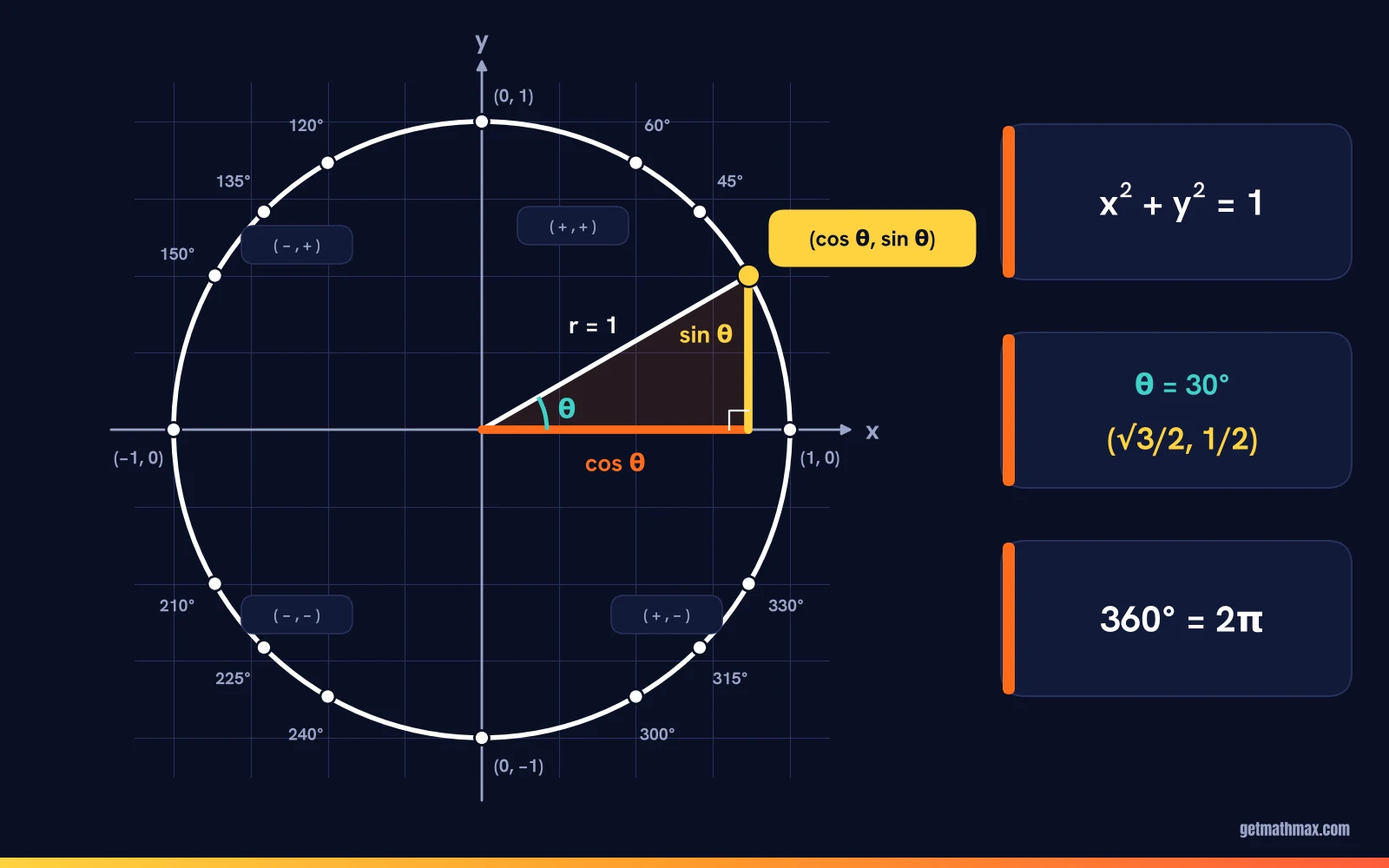
The unit circle is a circle with a radius of exactly 1 and its centre at the origin (0, 0). Every angle, measured anticlockwise from the positive x-axis, lands on one point of the circle. That point always has the coordinates (cos θ, sin θ). So the x-coordinate is the cosine of the angle and the y-coordinate is the sine.
Example
Take an angle of 30°. Draw a line from the centre at 30° above the x-axis until it hits the circle. The point where it lands is (√3/2, 1/2), which is about (0.866, 0.5). That tells you two things at once. The cosine of 30° is √3/2 and the sine of 30° is 1/2.
Every point on the circle also fits the equation x² + y² = 1. Check it with the 30° point. (√3/2)² + (1/2)² = 3/4 + 1/4 = 1. This equation is the Pythagorean theorem in disguise, because the radius is the long side of a right triangle with sides x and y.
Why is cosine the x-coordinate and sine the y-coordinate?
Many learners know SOH CAH TOA but don't see where the circle comes in. Draw a right triangle inside the circle, with the radius as its longest side (the hypotenuse). The bottom side runs along the x-axis and the vertical side goes up to the point on the circle.
Cosine is the adjacent side divided by the hypotenuse. On the unit circle the hypotenuse is 1, so the cosine is simply the length of the bottom side, which is the x-coordinate. In the same way, sine is the opposite side divided by 1, which is the height, or the y-coordinate. The circle just removes the division.
Why does the unit circle use radians?
The unit circle uses radians because, with a radius of 1, the angle in radians is exactly the length of the arc you travel around the circle. A full turn is 360°, and the full circumference of the circle is 2π. So 360° equals 2π radians, and 180° equals π radians.
Example
To change degrees into radians, multiply by π and divide by 180. For 60°, that gives 60 × π / 180 = π/3. To go back, multiply by 180 and divide by π. So π/4 radians is 180 / 4 = 45°.
Angles like π/8 often confuse learners because they don't appear on the standard chart. The trick is to think in fractions of a half turn. π is half a turn, π/4 is a quarter of that half turn (45°), and π/8 is half of π/4, which is 22.5°. You place it halfway between 0 and the 45° point.
Radians also matter later. In calculus, the rules for sine and cosine only work this neatly when angles are in radians. That is why teachers switch to radians as soon as the unit circle appears.
How do you remember the unit circle without memorizing it?
You only need the values for 0°, 30°, 45°, 60° and 90°. Everything else on the circle is a mirror image of these five. Below are three ways to rebuild them, and none of them depends on a phrase in one language. Pick the one that feels most natural.
Rebuild it from two triangles
Cut a square along its diagonal and you get a right triangle with two 45° angles, so its two short sides are equal. Make the long side 1, like the radius. The two short sides then have to fit x² + y² = 1, and with x = y that means each one is √2/2. So the 45° point is (√2/2, √2/2).
Now draw an equilateral triangle with sides of 2 and cut it in half. You get a triangle with angles of 30°, 60° and 90°, with sides 1, √3 and 2. Divide every side by 2 so the long side becomes 1. The sides are now 1/2, √3/2 and 1, which gives you the points for 30° and 60°.
Use the square root pattern
Write the numbers 0, 1, 2, 3, 4 under the angles 0°, 30°, 45°, 60°, 90°. Take the square root of each number and divide by 2. That row gives you the sine of each angle. Read the same row backwards for the cosine.
- Sine for 0°, 30°, 45°, 60°, 90°: √0/2 = 0, √1/2 = 1/2, √2/2, √3/2, √4/2 = 1
- Cosine for the same angles: √4/2 = 1, √3/2, √2/2, √1/2 = 1/2, √0/2 = 0
Count it on your hand
Hold up your left hand, palm facing you. Your thumb stands for 90°, then your index finger for 60°, your middle finger for 45°, your ring finger for 30° and your little finger for 0°. To find the values for an angle, fold down its finger.
Count the fingers on the little-finger side of the folded one, take the square root of that number and divide by 2. That gives the sine. The fingers on the thumb side give the cosine in the same way.
For 30°, fold your ring finger. One finger (the little finger) is on its little-finger side, so the sine is √1/2 = 1/2. Three fingers are on its thumb side, so the cosine is √3/2.
Each method gives the same five points. A few rounds in the trigonometry game show quickly whether you can recall sine and cosine values under a little time pressure. Short, frequent practice like this makes the values stick far better than one long session.
Do you need to memorize the whole unit circle?
No. You need the first quadrant (0° to 90°) and a reliable way to reflect it. Learners who memorize the full chart for a test often forget it a few weeks later. Learners who understand the triangles and the reflections can rebuild it at any time, and that is what later topics such as calculus actually ask for.
How do the signs change in each quadrant?
The circle has four quadrants. In each one, the sizes of the coordinates match a first-quadrant angle, and only the signs change. In the first quadrant x and y are both positive. In the second, x is negative. In the third, both are negative. In the fourth, y is negative.
Example
Find the point for 150°. It sits in the second quadrant, 30° short of 180°. So it is the mirror image of the 30° point across the y-axis. The 30° point is (√3/2, 1/2). Mirroring it makes the x-coordinate negative, so the 150° point is (−√3/2, 1/2).
- First quadrant (0° to 90°): x is positive, y is positive
- Second quadrant (90° to 180°): x is negative, y is positive
- Third quadrant (180° to 270°): x is negative, y is negative
- Fourth quadrant (270° to 360°): x is positive, y is negative
A quick check is to picture the point on a normal graph. Left of the y-axis means x is negative, and below the x-axis means y is negative. You don't need to memorize this list if you can picture where the point lies.
What is tan on the unit circle?
The tangent of an angle is the y-coordinate divided by the x-coordinate, so tan θ = sin θ / cos θ. For 60°, that is (√3/2) ÷ (1/2) = √3, about 1.732. At 90° and 270° the x-coordinate is 0, and you can't divide by 0, so the tangent is undefined at those angles.
What is the unit circle used for?
The unit circle is the reason sine and cosine work for any angle, not just the angles inside a right triangle. That makes it the basis for anything that repeats or turns. Sound waves, light waves, alternating current, the motion of a pendulum and the hands of a clock are all described with sine and cosine.
Example
Imagine a point moving around the circle at a steady speed. Its height goes up to 1, down to −1 and back again, in a smooth wave. Plot that height against time and you get the graph of the sine function. Engineers use exactly this idea to describe vibrations, and game and animation developers use it to rotate objects on screen.
One quadrant and two triangles give you the whole circle
Here are the main angles with their coordinates. Use the list as a reference, but try to rebuild each row with the triangles or the hand trick before you look.
- 0° (0): (1, 0), tan θ = 0
- 30° (π/6): (√3/2, 1/2), tan θ = √3/3
- 45° (π/4): (√2/2, √2/2), tan θ = 1
- 60° (π/3): (1/2, √3/2), tan θ = √3
- 90° (π/2): (0, 1), tan θ = undefined
- 120° (2π/3): (−1/2, √3/2), tan θ = −√3
- 135° (3π/4): (−√2/2, √2/2), tan θ = −1
- 150° (5π/6): (−√3/2, 1/2), tan θ = −√3/3
- 180° (π): (−1, 0), tan θ = 0
- 210° (7π/6): (−√3/2, −1/2), tan θ = √3/3
- 225° (5π/4): (−√2/2, −√2/2), tan θ = 1
- 240° (4π/3): (−1/2, −√3/2), tan θ = √3
- 270° (3π/2): (0, −1), tan θ = undefined
- 300° (5π/3): (1/2, −√3/2), tan θ = −√3
- 315° (7π/4): (√2/2, −√2/2), tan θ = −1
- 330° (11π/6): (√3/2, −1/2), tan θ = −√3/3
If a row feels hard, go back to the first quadrant, find the matching angle, and decide the signs from the quadrant. That one habit replaces the whole list.
Train these next