Perfect squares and square numbers
A perfect square is the number you get when you multiply a whole number by itself, like 9 = 3 × 3. Perfect squares are also called square numbers. The number you multiply by itself is the square root, so 3 is the square root of 9.
Knowing the first perfect squares from memory makes square roots, area and the Pythagorean theorem much faster.
What are the perfect squares from 1 to 100?
There are 10 perfect squares from 1 to 100. They are 1, 4, 9, 16, 25, 36, 49, 64, 81 and 100, the squares of the whole numbers 1 to 10. Each perfect square in the list is the result of a number times itself, so 64 is 8 × 8 and 100 is 10 × 10.
The list of perfect squares from 1 to 100
- 1 × 1 = 1
- 2 × 2 = 4
- 3 × 3 = 9
- 4 × 4 = 16
- 5 × 5 = 25
- 6 × 6 = 36
- 7 × 7 = 49
- 8 × 8 = 64
- 9 × 9 = 81
- 10 × 10 = 100
You will also see these written with a small 2, such as 7² = 49. You read 7² as "7 squared". The small 2 is an exponent, and it means the number is used twice in a multiplication.
On a multiplication chart, all of these numbers sit on the diagonal from the top left to the bottom right. That diagonal is where a row and a column with the same number meet.
What are the perfect squares from 100 to 400?
The perfect squares from 100 to 400 are 100, 121, 144, 169, 196, 225, 256, 289, 324, 361 and 400. They are the squares of the whole numbers 10 to 20, so there are 11 of them if you count both 100 and 400. The 10 after 100, from 11² to 20², are listed below.
- 11² = 121
- 12² = 144
- 13² = 169
- 14² = 196
- 15² = 225
- 16² = 256
- 17² = 289
- 18² = 324
- 19² = 361
- 20² = 400
It also helps to memorize these, because 121, 144, 169 and 225 come up often in geometry and in square roots.
Why are they called square numbers?
They are called square numbers because that many dots or tiles can be arranged into a full square. Nine dots fit into a square of 3 rows and 3 columns, so 9 is a square number. Ten dots cannot make a full square, so 10 is not a square number. The side of the square is the square root.
Example with dots
Start with 1 dot. Add 3 dots around one corner and you get a 2 by 2 square of 4 dots. Add 5 more dots around the corner and you get a 3 by 3 square of 9 dots. Add 7 more and you get a 4 by 4 square of 16 dots.
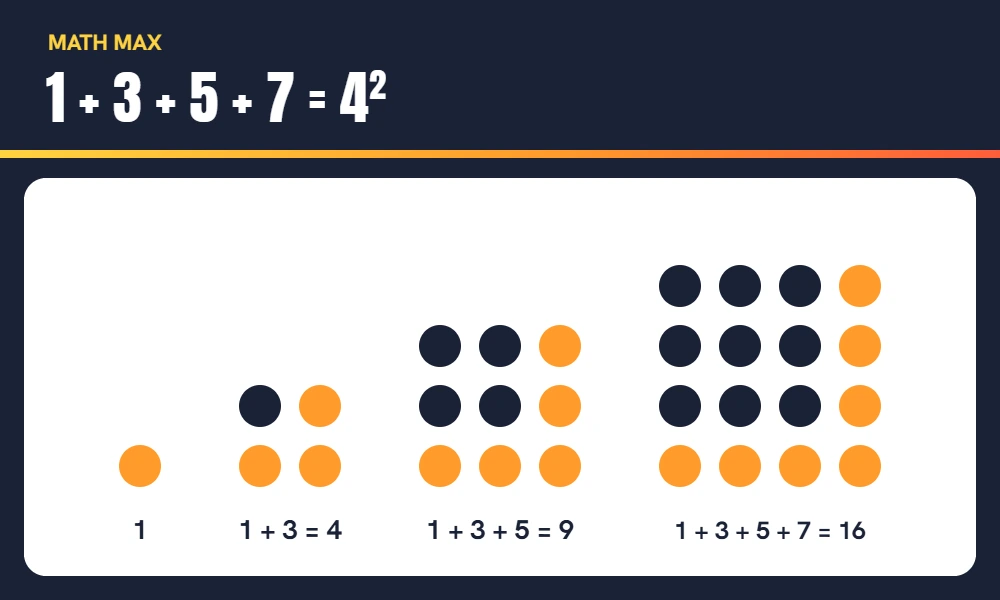
The diagram shows a pattern in the list. Each perfect square is the sum of the first odd numbers, starting at 1. So 1 + 3 + 5 + 7 = 16, and adding the first 10 odd numbers gives 100. It works because each new layer adds one row and one column to the square, plus the dot in the corner. You can test it yourself by drawing a larger square of dots.
The same pattern tells you how far apart two neighboring perfect squares are. From one perfect square to the next, you always add the next odd number. From 7² = 49 to 8² = 64 is a jump of 15, which is 7 + 8.
How can you tell if a number is a perfect square?
To spot a perfect square, check four things. The last digit must be 0, 1, 4, 5, 6 or 9. The digits, added until one digit is left, must give 1, 4, 7 or 9. Any zeros at the end must come in pairs. Last, every prime factor must appear an even number of times, which settles it.
Check the last digit
A perfect square can only end in 0, 1, 4, 5, 6 or 9. A number ending in 2, 3, 7 or 8 is never a perfect square. So 2,023 and 4,568 are not perfect squares. The reason is that the last digit of a square depends only on the last digit of the number you square. The squares of 0 to 9 end in 0, 1, 4, 9, 6, 5, 6, 9, 4 and 1, so no other ending is possible.
A possible last digit does not prove anything on its own. The number 19 ends in 9, but it is not a perfect square. The last digit can only rule numbers out.
Add up the digits
Add the digits, and keep adding until you have one digit. This is called the digital root. For a perfect square other than 0, the result is always 1, 4, 7 or 9. The reason is that the digital root of a square depends only on the digital root of the number you square. The squares of 1 to 9 have digital roots 1, 4, 9, 7, 7, 9, 4, 1 and 9, so no other result is possible.
- 2,024 has digits 2 + 0 + 2 + 4 = 8. Since 8 is not 1, 4, 7 or 9, 2,024 is not a perfect square.
- 1,296 has digits 1 + 2 + 9 + 6 = 18, and 1 + 8 = 9. It passes, and in fact 1,296 = 36².
Like the last digit, this check can only rule numbers out. The number 13 has a digital root of 4, but it is not a perfect square.
Count the zeros at the end
A perfect square that ends in zeros always ends in an even number of them. For example, 100, 400 and 3,600 end in two zeros and are perfect squares. A number like 1,000 or 40,000,000 that ends in an odd number of zeros can never be one. The reason is that each zero at the end of a number gives two zeros at the end of its square, so 30² = 900 and 600² = 360,000.
Split the number into prime factors
A number is a perfect square exactly when every prime in its factorization appears an even number of times. This test always gives the right answer, and it also gives you the square root.
For example, 784 = 2 × 2 × 2 × 2 × 7 × 7. The 2 appears four times and the 7 appears twice, so 784 is a perfect square. Pair the factors up and you get its square root, 2 × 2 × 7 = 28. By contrast, 72 = 2 × 2 × 2 × 3 × 3 has three 2s, so 72 is not a perfect square.
How do perfect squares help with square roots?
Perfect squares are the numbers whose square roots are whole numbers. If you know the list, you know their square roots immediately, so the square root of 81 is 9 and the square root of 144 is 12. For any other number, the two nearest perfect squares tell you which two whole numbers the square root lies between.
Example of estimating a square root
Estimate the square root of 50. The nearest perfect squares are 49 = 7² and 64 = 8². Since 50 lies between them, its square root lies between 7 and 8. Because 50 is very close to 49, the square root is just above 7. A calculator gives about 7.07.
Perfect squares also simplify square roots. The square root of 72 is the square root of 36 × 2, and since 36 is a perfect square, that becomes 6 times the square root of 2.
In the square roots game, every attack in a Math Max fight is a square root problem, so you practice the squares from the list above with each answer. The exponents game covers squares, cubes and other powers in the same way. Both are free to play in the browser.
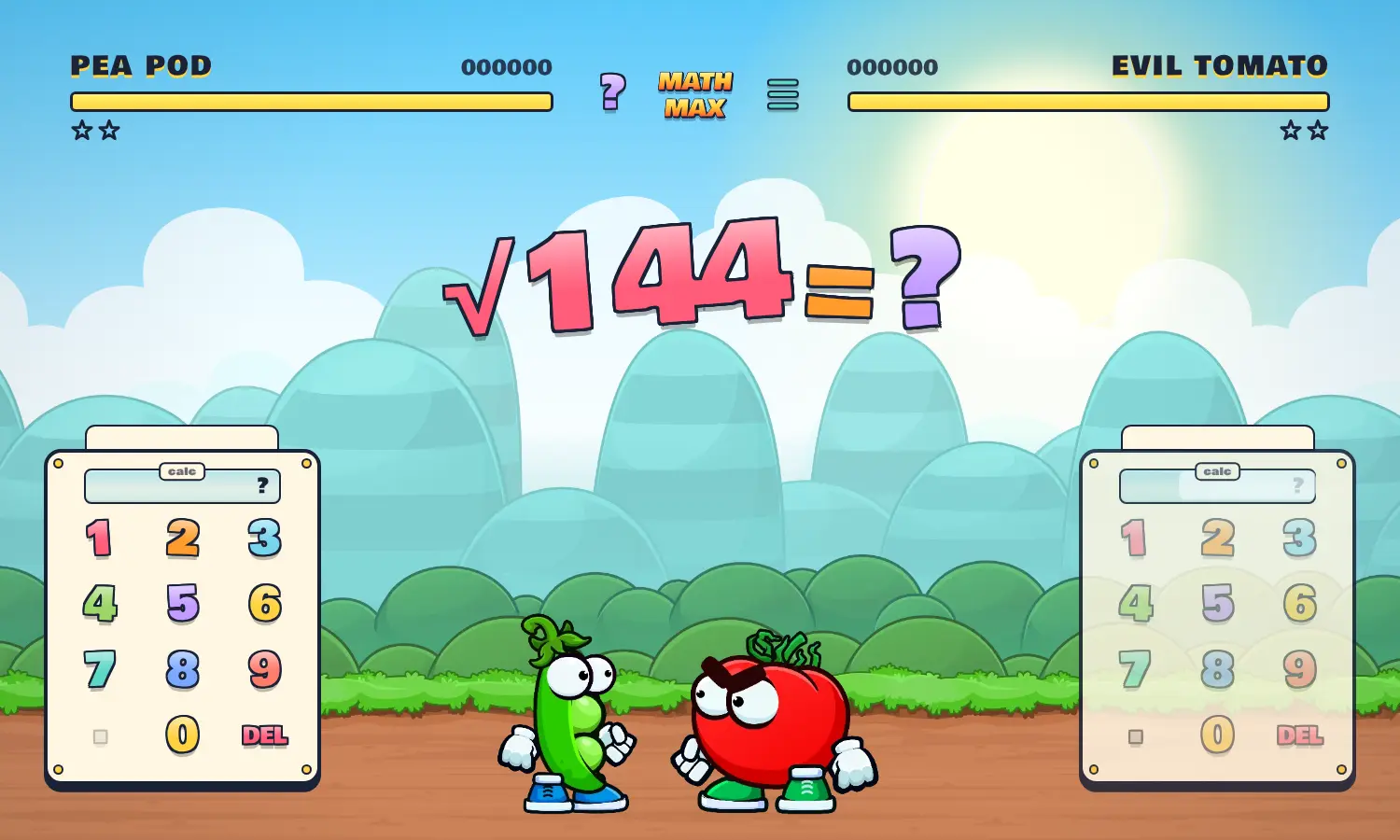
The answer to the round above is 12, because 12 × 12 = 144.
Is 0 a perfect square, and can a perfect square be negative?
Yes, 0 is a perfect square, because 0 × 0 = 0. Many lists start at 1, but 0 fits the definition of a perfect square. A perfect square cannot be negative, because a number times itself is never negative. Both 5 × 5 and (−5) × (−5) give 25.
Two square roots for every square
That last fact means every positive perfect square has two square roots. The number 49 has the square roots 7 and −7, because both 7 × 7 and (−7) × (−7) equal 49. When people say "the square root of 49", they usually mean the positive one, 7.
A common mistake is to think −49 is a perfect square because 49 is. No number times itself gives −49, so it is not.
Can a fraction or a decimal be a perfect square?
Usually not, because in most lessons a perfect square means a whole number, and that is the meaning used here. Some textbooks do call a fraction a perfect square when, in simplest form, its top and bottom are both perfect squares, such as 4/9 = (2/3)². In the same way, a decimal like 0.25 = 0.5² is sometimes called one.
What are some tricks for squaring numbers quickly?
Two patterns make many squares easy in your head. For a number ending in 5, multiply the number in front of the 5 by the next number up and write 25 after it. To square the next number up from one you know, add both numbers to the square you know. You can check both by multiplying the numbers out.
Examples of quick squaring
Squaring numbers that end in 5:
- 35²: 3 × 4 = 12, then write 25, so 35² = 1,225.
- 65²: 6 × 7 = 42, then write 25, so 65² = 4,225.
- 85²: 8 × 9 = 72, then write 25, so 85² = 7,225.
Squaring the next number up:
- 21² = 20² + 20 + 21 = 400 + 41 = 441.
- 31² = 30² + 30 + 31 = 900 + 61 = 961.
The second trick works because a new layer of dots adds one row, one column and one corner dot, as in the diagram above.
More shortcuts like these are in our guide to mental math tricks. Practice one trick at a time.
Perfect squares are the numbers that make a full square
Perfect squares are the whole numbers you can lay out as a full square of dots, which is the same as a number times itself. Learn the 10 from 1 to 100, then use the last digit, the digital root and the zeros to rule numbers out quickly. When you need certainty, the prime factors or the square root give the final answer.
Train these next