What is a prime?
Is 1 a prime number? No. A prime number is a whole number with exactly two different factors, 1 and the number itself. For example, 7 is prime because only 1 and 7 divide it evenly. The number 1 has just one factor, so it falls short of that rule. It is not composite either, which puts 1 in a group of its own.
Is 1 a prime number?
No, 1 is not a prime number. A prime needs exactly two different factors, and 1 has only one. It is not composite either, because composite numbers have more than two factors. So mathematicians class 1 as neither prime nor composite. The smallest prime number is 2, with the factors 1 and 2.
Example
Here are the factors of the numbers 1 to 6.
- 1 has one factor (1), so it is neither prime nor composite.
- 2 has two factors (1 and 2), so it is prime.
- 3 has two factors (1 and 3), so it is prime.
- 4 has three factors (1, 2 and 4), so it is composite.
- 5 has two factors (1 and 5), so it is prime.
- 6 has four factors (1, 2, 3 and 6), so it is composite.
Only 1 has a single factor. Every prime has exactly two, and every composite has three or more.
Seeing it with dots
Try this with dots on paper or small objects like buttons. Six dots can be arranged as a rectangle of 2 rows of 3, so 6 is composite. Seven dots can only make a single row of 7, however you try, so 7 is prime. With one dot there is nothing to arrange at all, which shows in another way that 1 behaves differently.
Why so many people think 1 is prime
Many of us learned that a prime is a number "divisible only by 1 and itself." By that wording, 1 seems to qualify. The catch is that 1 and "itself" are the same number here, which gives one factor, not two. That is why careful definitions say exactly two different factors, or "a whole number greater than 1" that is divisible only by 1 and itself.
You may also read online that 1 "used to be prime." The real history is more mixed. Ancient Greek mathematicians did not treat 1 as a number at all, and later mathematicians disagreed about it. As Scientific American explains in its history of the question, the British mathematician G. H. Hardy still listed 1 as a prime in early editions of his textbook and changed this in 1938. Today mathematicians agree that 1 is not prime.
Adults who studied math for years sometimes hesitate here too. If your child called 1 a prime and the answer was marked wrong, the reasoning was not silly. The rule they remembered was simply missing one small detail.
Is 2 a prime number?
Yes. The number 2 is the smallest prime and the only even one. Every other even number can be divided by 2, which gives it at least three factors (1, 2 and itself). So after 2, every prime is odd, although plenty of odd numbers are composite.
Is 0 a prime number?
No. Zero is neither prime nor composite. Every whole number except 0 divides evenly into 0, so 0 has far more than two factors. Prime and composite are only used for whole numbers greater than 1, which leaves both 0 and 1 outside those two groups.
How can you tell quickly if a number is prime?
Divide the number only by small primes, starting with 2, 3, 5 and 7. You can stop once the prime you are testing, multiplied by itself, is bigger than your number. If none of those primes divides evenly, the number is prime. For any number below 100, testing 2, 3, 5 and 7 is enough.
Example
Is 91 prime?
- It is odd, so 2 does not divide it.
- Its digits add up to 9 + 1 = 10. That is not a multiple of 3, so 3 does not divide it.
- It does not end in 0 or 5, so 5 does not divide it.
- Try 7. Since 7 × 13 = 91, the number 91 is not prime.
Is 97 prime? It is odd, its digits add up to 16, and it does not end in 0 or 5. Dividing gives 97 ÷ 7 = 13 with remainder 6. The next prime is 11, and 11 × 11 = 121 is already bigger than 97. You can stop there, so 97 is prime.
Why you can stop early
Factors come in pairs. For 36, the pairs are 1 × 36, 2 × 18, 3 × 12, 4 × 9 and 6 × 6. In every pair, one factor is 6 or smaller, because 6 × 6 = 36. So if you find no factor up to that point, there is none beyond it either.
The quick filters
- If a number ends in 0, 2, 4, 6 or 8, it is divisible by 2. Only 2 itself is prime.
- If the digits add up to a multiple of 3, the number is divisible by 3. Only 3 itself is prime.
- If a number ends in 0 or 5, it is divisible by 5. Only 5 itself is prime.
- For 7, just divide.
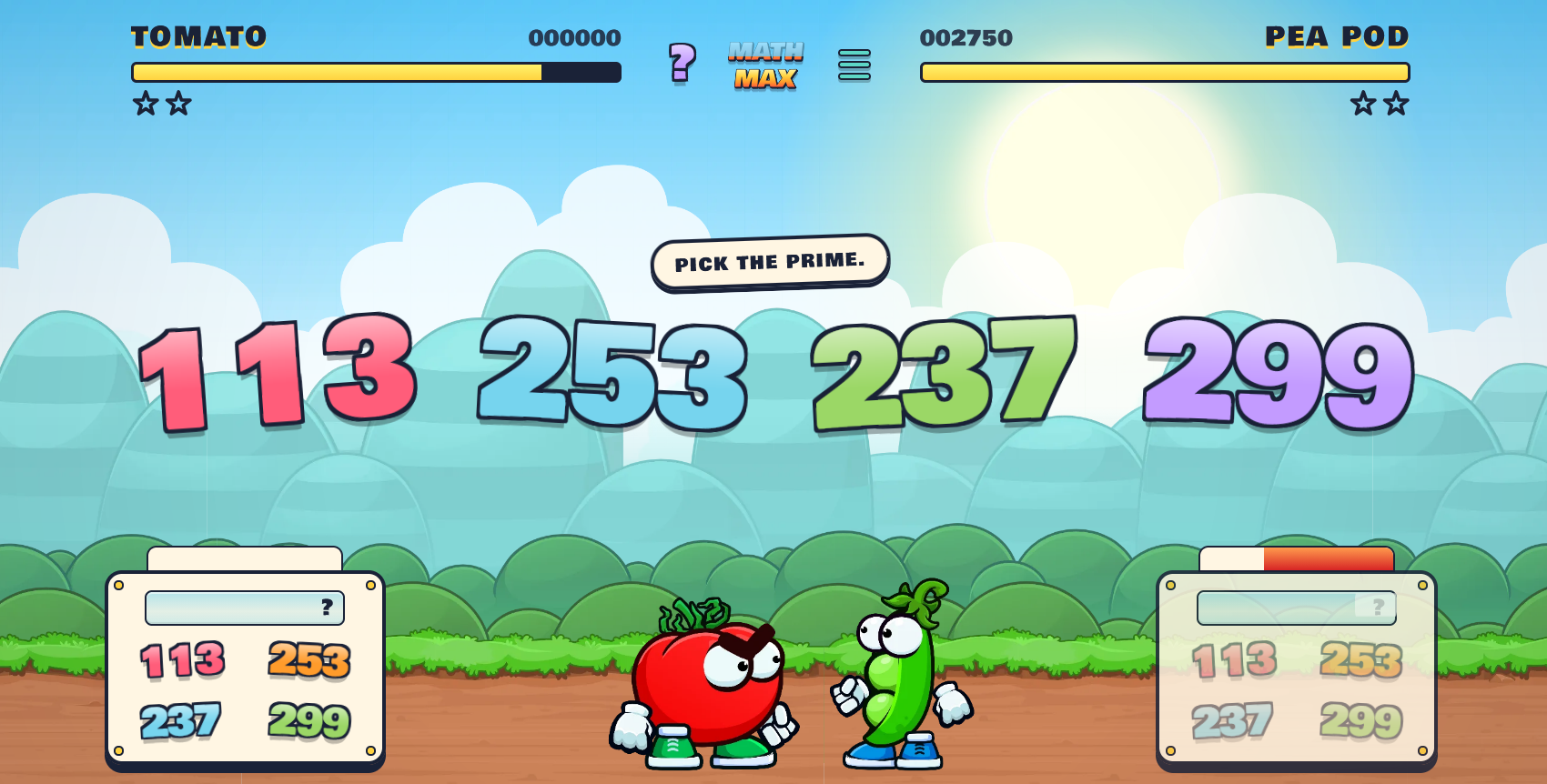
Speed comes from seeing many numbers. Once the filters feel familiar, a few rounds of spotting primes against the clock in Math Max turn them into habit, because every correct answer is an attack on the other fighter. It runs free in the browser, so there is nothing to install.
Which numbers look prime but aren't?
The classic trap numbers are 51, 57 and 91. They are odd, they do not end in 5, and they feel prime. But 51 = 3 × 17, 57 = 3 × 19 and 91 = 7 × 13. Most trap numbers are caught by the digit sum test for 3 or by a quick division by 7.
Example
- 39 = 3 × 13. Its digits add up to 12, a multiple of 3.
- 51 = 3 × 17. Its digits add up to 6, a multiple of 3.
- 57 = 3 × 19. Its digits add up to 12, a multiple of 3.
- 87 = 3 × 29. Its digits add up to 15, a multiple of 3.
- 91 = 7 × 13. Dividing by 7 catches it.
- 119 = 7 × 17. Dividing by 7 catches it.
- 133 = 7 × 19. Dividing by 7 catches it.
Even experts get caught
The number 57 is jokingly called the Grothendieck prime, after a story that the famous mathematician Alexander Grothendieck once used it as an example of a prime.
When the math blog The Aperiodical analysed results from an online "Is this prime?" game, 51 was mistaken for a prime even more often than 57. Many players also called 39 prime. The prime most often wrongly called composite was 59, so mistakes go both ways.
Two false shortcuts cause most of these slips. One is "odd numbers are prime," which 9, 15 and 21 disprove. The other is "numbers ending in 1, 3, 7 or 9 are prime," but those endings only rule out 2 and 5 as factors.
Prime numbers up to 100
When in doubt, check against the list. There are 25 prime numbers below 100: 2, 3, 5, 7, 11, 13, 17, 19, 23, 29, 31, 37, 41, 43, 47, 53, 59, 61, 67, 71, 73, 79, 83, 89 and 97.
The list never ends, because the ancient Greek mathematician Euclid proved that there are infinitely many primes.
Two different factors is the whole rule
A prime needs exactly two different factors, and 1 has only one, so 1 is not prime. The same rule explains why 2 is prime and why 0 is not. To check a number fast, test small primes, stop at the square root and watch for traps like 51 and 91.
Train these next