How do you remember which sign is greater than?
Look at the open side of the greater than and less than signs. The wide end of > or < always faces the bigger number, and the narrow point always faces the smaller one. So 9 > 4 and 4 < 9 both open towards 9. The rule works for any numbers, including negatives and decimals.
Example
Compare 7 and 3.
- 7 is bigger, so the open side has to face 7.
- If 7 comes first, you write 7 > 3.
- If 3 comes first, you write 3 < 7.
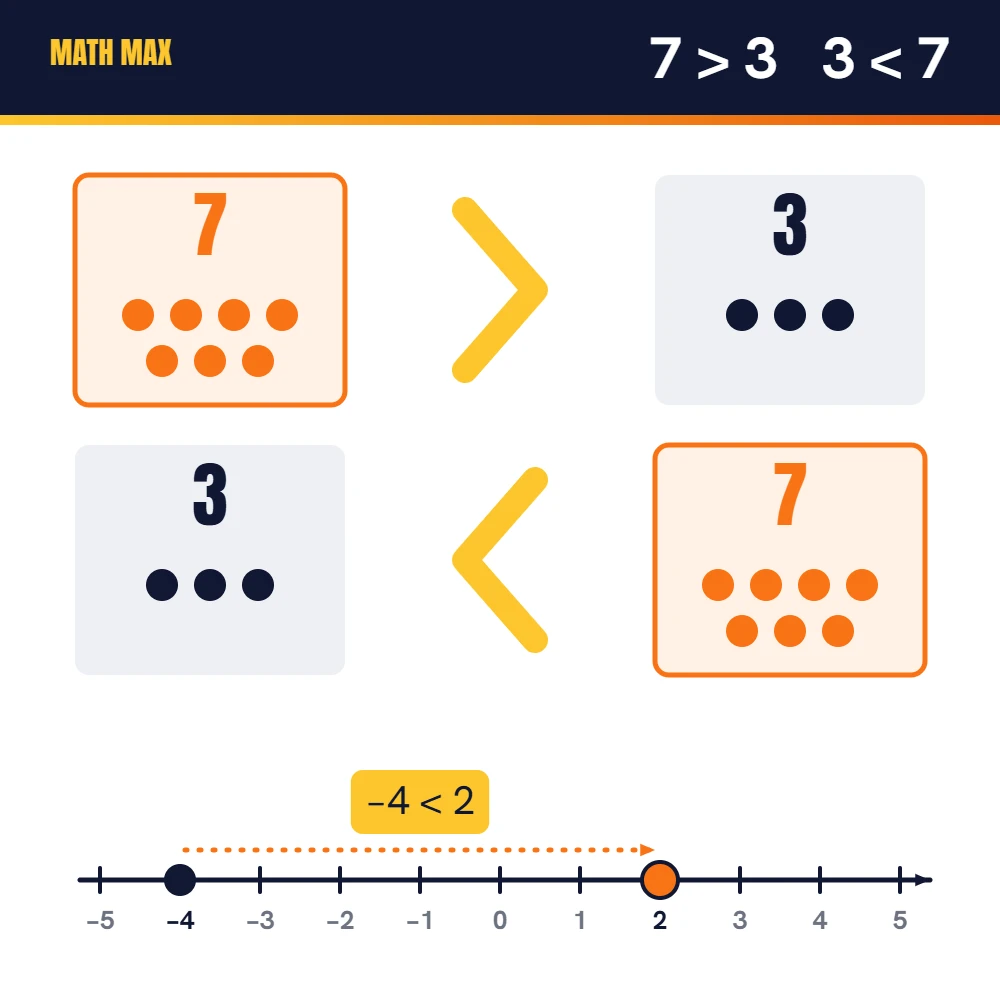
Both lines in the picture describe the same fact. The only thing that decides which sign you need is the order you write the numbers in.
Three visual tricks children can use
Different children like different tricks. Try two of them and keep the one your child uses.
- The hungry mouth. The sign is an open mouth, often drawn as a crocodile, and it always eats the bigger number. Children like adding teeth.
- Big side, small side. One end of the sign is wide and the other is a tiny point. Wide end next to the big number, point next to the small one.
- Two dots and one dot. Put two dots beside the bigger number and one dot beside the smaller number. Join the two dots to the single dot, and the lines form the right sign.
With the mouth trick, children sometimes remember the mouth but not what it eats. Saying "it eats the bigger one" out loud every time helps.
How do you read greater than and less than out loud?
Read the signs from left to right, the same way you read a sentence. Say the left number, then the sign, then the right number. So 3 < 8 is "3 is less than 8", and 8 > 3 is "8 is greater than 3". Both sentences say the same thing about 3 and 8.
Example
Read 12 > 5 and 5 < 12.
- 12 > 5: "12 is greater than 5".
- 5 < 12: "5 is less than 12".
The free textbook OpenStax Prealgebra 2e teaches the same reading, with a < b read as "a is less than b". Children who start from the right-hand number often say the wrong sign. Pointing at each part while you read keeps the order clear.
How do you compare larger numbers and decimals?
Count the digits first. A positive whole number with more digits is the bigger one. If both numbers have the same number of digits, compare them place by place starting from the left, and the first place where they differ settles it. Decimals work the same way once the decimal points are lined up.
Example
Compare 4,512 and 4,521.
- Both have four digits.
- Thousands: 4 and 4.
- Hundreds: 5 and 5.
- Tens: 1 and 2. That's the first difference, and 1 < 2.
So 4,512 < 4,521. Decimals trip children up more often, because a longer decimal looks bigger. Take 0.5 and 0.45. Write 0.5 as 0.50, and now you're comparing 50 hundredths with 45 hundredths. So 0.5 > 0.45. The decimals game is full of comparisons like this one. Ask your child to write the extra zero every time, even when it looks unnecessary.
How do greater than and less than work with negative numbers?
Picture a number line. The further right a number sits, the greater it is, and the further left, the smaller. That's why −4 < 2, and also why −7 < −3, even though 7 is bigger than 3. With two negative numbers, the one closer to zero is the greater number, which can feel strange at first.
Example
Compare −7 and −3.
- On a number line, −3 sits to the right of −7.
- Further right means greater, so −3 > −7.
- Turned around, the same fact reads −7 < −3.
Temperature is a handy check. −3 °C is warmer than −7 °C, so −3 really is the greater number. Once the basic signs are secure, the negative numbers game gives plenty of practice. At the start, keep a number line drawn on paper next to the screen.
What do ≥ and ≤ mean?
The sign ≥ means greater than or equal to, and ≤ means less than or equal to. The line underneath is half of an equals sign. So x ≥ 5 allows 5 itself and every number above it, while x ≤ 5 allows 5 and every number below it. Without the line, the number 5 itself would not be included.
Example
A board game needs at least 2 players and at most 6. With p players, that's p ≥ 2 and p ≤ 6. Two players is fine, because 2 = 2. Seven players breaks the rule p ≤ 6. One more sign is worth knowing here: ≠ means not equal to, so 7 ≠ 6.
In algebra these signs turn into inequalities, where the answer is a whole range of numbers instead of one value. The inequalities game is the next step for older children. The open side still faces the bigger value.
How can you practise comparing numbers at home?
Keep it short and make it part of everyday moments. Children need lots of quick comparisons, and saying each one out loud helps them remember which sign is which. A few minutes at a time is enough. Dice, playing cards and a number line drawn on paper are all you need to get started.
Ideas that need almost nothing
- Each of you rolls a die. The higher number wins, and the winner writes the sign between the two numbers.
- Turn over two playing cards and ask which sign goes between them before anyone says the answer.
- Draw a number line from −10 to 10, put two counters on it, and ask which one is greater.
When you want something that keeps going on its own, try the comparing numbers game. Each round shows two numbers and asks which sign fits, with <, = and > to choose from, and a correct answer lands your attack.
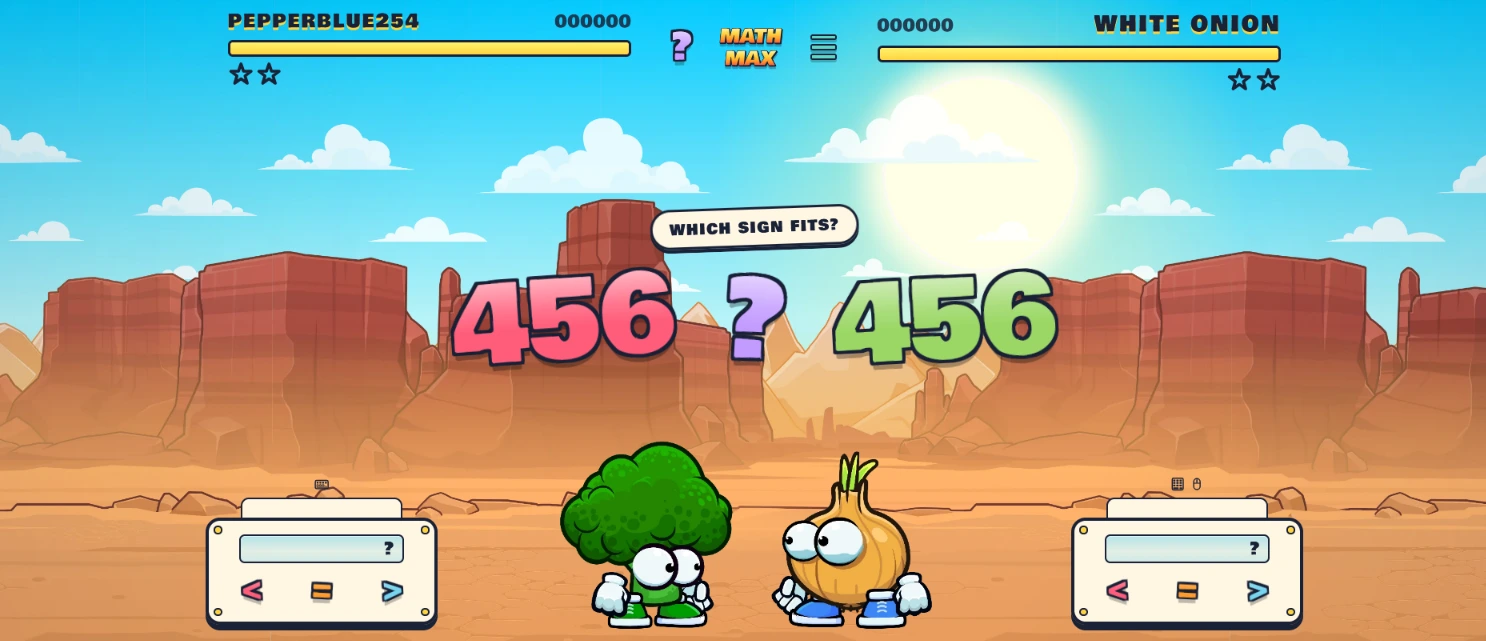
The round in the picture is a nice trap. Both numbers are 456, so the answer is the equals sign.
Who invented the greater than and less than signs?
The signs < and > first appeared in print in a book on algebra published under the name of the English mathematician Thomas Harriot. It came out in 1631, ten years after he died. The history of mathematics archive MacTutor records this. It also notes that Harriot himself was not directly responsible for that book.
Example
Before these signs existed, people wrote comparisons out in words. Instead of 1,000 > 999, a book would print the whole sentence 1,000 is greater than 999. The short signs made long calculations much easier to read and check.
The open side always faces the greater number
Every comparison comes back to one idea. The open side of the sign faces the greater number, and the point faces the smaller one. Once a child has that, the same sign works for big numbers, decimals and negative numbers, and later for inequalities in algebra.
Train these next